

This is Part 2, of a two-story series on Camille Paglia.
Read Part 1, here.
I’m part of a 12-step group you may not have heard of. Yes, it’s adjacent to Al-Anon, but with its own special “qualifier.” We have all loved and lost with Professor Paglia. We thought we could handle it— we couldn’t.
I won’t hide the fact anymore that Camille ripped me to shreds in blistering sheafs of stationery. She broke the fountain pen, from the appearance of the splotches.
And I replied to her with abject kindness. I was raised that way!
“But what went wrong?” you ask.
I was flattered by her passion at first; like so many. I couldn’t imagine why she spent her precious time reducing me to a loathsome little worm.
In recovery, I realize I am common. My plight is banal. So many have received hate mail from CP, and then tried to make up in vain.
Our first step: to admit we are powerless over Camille.
I look forward to attend “Camille Anonymous” meetings with her ex-car mechanics, her ex-hairdressers, her ex-lovers, and of course her chain of intellectual nemeses. Come out, come out, wherever you are.
I’ll get up from my folding chair and tell the truth: I couldn’t stop reading Camille — not only her books, but her media blasts, her satiric retorts to everything from Monday night football to kiddie porn. Her homages to Greta Garbo and Princess Diana. She could deconstruct celebrity and perversion like no one else.
My friends tried to warn me; they said, “Camille Paglia is not a laugh. She is not a art wit. She is a tool of the right wing.”
“Hey, you are dead wrong.” I told them. “Camille is not a tool— she is a weather phenomenon.”
If you think Ted Cruz calls up Hurricane Camille for strategy sessions, you’ve got another thing coming. Monkey wrench, maybe; tool, never.
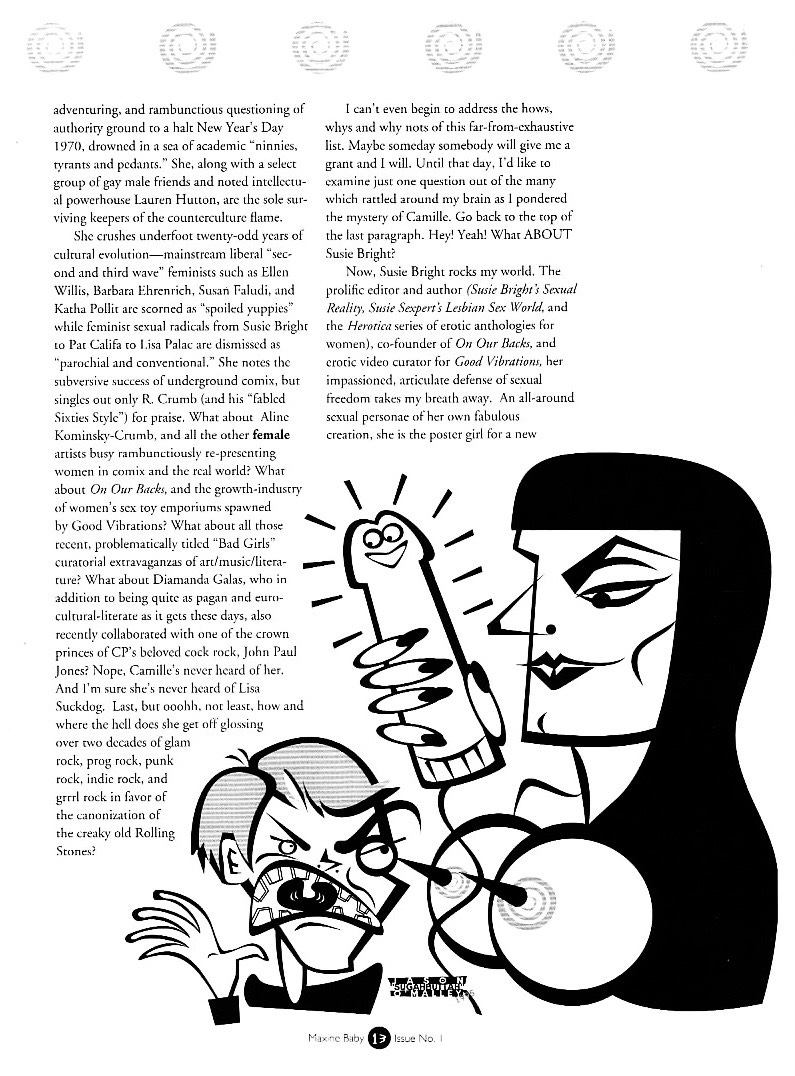
When I first met Camille, she was an unknown. She came to a reading of my book Susie Sexpert’s Lesbian Sex World, a couple months after she released her own Sexual Personae. She popped up during my lecture like a jack-in-the-box, saying she was my “only friend in academia” and laying into the fragile Institution of liberal humanities, like she was punching the Pillsbury dough‑boy right in the kazoo.
Her ferociousness took me aback. Of course I’ve had my own battles with a certain Prime of Miss Jean Brodie atmosphere that turns undergraduates into soldiers against whatever they think constitutes “vice.”
But I’ve also made allies on campus who are sexually adventurous and thoughtful. There’s lots of us. I wondered how Camille could imagine she was the only one.
I interviewed Camille a year after we met, in 1991, in a two-hour phone call. I was surprised to learn that she was willing to discuss how her theories about sex intersected with her own sex life. She was new to media interviews, and she opened up.
Sometimes she’d hold up a fig leaf of privacy to my outrageous questions. But it was a great improvement over the occasion I asked an elder Susan Sontag, still in the closet, what she thought of lesbian-made erotic works. Sontag turned her head away like someone had taken a dump on the carpet.
Camille, on the other hand, was candid about her life and childhood. She saw herself as unique at nine years old, as she is today.
She admitted she exaggerates to make her points; she thinks of it as guerrilla word-fare. I understood her hyperbole, it was so GAY. Camp.
Camille’s critics imagined she would pass by a woman getting raped on the street and only sneer, because she’s said publicly women need to stop being such . . . “victims.”
But that’s not her truer story. Paglia is the type who would fight a man twice her size (and she did!) if he was even condescending to a woman, let alone assaulting her. She is chivalrous, and hates a bully.
Yet she is a bully.
She says outrageous things you can poke holes in, and she dares you to start poking back. Right and Fight Makes Might in Camille’s battles for justice, and no one can outdo her rapid fire authority.
I had approached our ‘91 interview with deference. She was older than me. She reminds me of people I’ve loved. I laughed at her wild swings, and somehow that was the grease.
But everyone gets over-sensitive sometimes, and Camille finally punched my clock.
In 1995, well into her fame, Paglia began an essay in Playboy with a boast: “I am a pornographer.”
“You are not!” I yelled in my bed, where I ordinarily loved to feast on Camille editorials.“What do you know about being persecuted for sex?”
Whatever criticism gets leveled at Camille, her snubs from academia and New York, she never went to jail for dissing Susan Faludi. No one tried to kill her.
Furthermore, no one called her a slut. She was a woman who kept her clothes on, this country’s criterion for virtue. She is a lifelong academic, not an activist or a “purveyor of obscene material.” Her risks were different.
I don’t know why, in that moment, I got irate at Camille her putting on the cloak of porn martyrdom. Finally, I was offended! It could have happened a million times before.
Many Camille-aholics say this was the first step toward recovery. In my case it only upped the ante.
I wanted to show Camille the other side of lesbian life and women’s bohemia, to pierce her lonely tower. I wanted to see the narcissistic mask drop. For all Paglia’s education, she seemed isolated to me.
Thus, in 1992, when it was announced Paglia was coming to San Francisco to lecture at the Herbst Theatre, I faxed her a note suggesting we paint the town red.
Never heard from her.
Meanwhile, I was invited by the Herbst Theater showrunner to interview Paglia on stage. I thought that would be fun. I wanted to show slides of classical art and contemporary porn/erotica to elicit her stream of consciousness reactions. I love hearing her take on sexual representation. We’d talked about it before.
Well, things did not turn out that way.
Camille never talked to me. Various intermediaries did; they said that Camille was doing her act solo, and I could introduce her if I liked, two minutes. It was all very officious.
I didn’t appreciate the string of middlemen. Why couldn’t she talk to me herself? That ticked me off. Camille was not making her customary direct hit. Fame had changed her, what else is new?
After her successful show, reporters swarmed the auditorium, hoping to get an outraged feminist reaction, or an outraged something. I pulled a Lloyd Bentsen with a microphone’d journalist, saying, “Camille, you’re no pornographer.”
I guess she read her clippings.
Two months after Paglia’s lecture, I was in bed with a bout of grave pneumonia. An envelope from the University of the Arts in Philadelphia arrived. It was from Camille.
It was the meanest thing ever addressed to me in my life.
She was furious that I had not introduced her at the Herbst. How dare I say she had not “paid the price of her beliefs”?
“I have been unemployed,” she retorted, “unpublished, kicked out of one job, insulted to my face.”
She called me a diva, a naïf, solipsistic. “Wake up to reality,” she repeated. “Establishment feminism has destroyed women’s education. Don’t you see the destructiveness of the date-rape hysteria? I’ve taken more abuse on that alone than you ever have— hostility and defamation from Alaska to Miami . . . You lost big by your behavior toward me this trip.”
I wondered what my punishment might be, and she delivered it, in an inky postscript:
“I had been speaking positively about your new book — all this is now over.
“You have shown your true colors.”
Yikes! If I hadn’t gotten my next cortisone shot in the minutes following her letter’s revelations, I might’ve dropped on the spot.
Had I finally reached my bottom, was I willing to say no to the ridiculous?
Not yet.
I spent the next day writing Camille, saying I wished she had spent a moment talking to me in person so things hadn’t gotten ugly. I didn’t belittle the risks she’d taken with her career. I said I’d like to introduce her to a few people who might surprise her. Who’d fought the law. I told her not to believe everything she read in the paper.
I wrote, “I am not your enemy.”
I hoped that this approach demonstrated turning the other cheek, rather than exhibiting my codependency. How could she go from being my “only friend in academia” to my apoplectic adversary?
The last shoe dropped the day after Christmas. I got another envelope from the Philadelphia University of the Arts — this time, a big folder. Inside was my unopened letter, and the following message on letterhead:
“Due to the overwhelming volume of international mail, Professor Paglia cannot accept unsolicited packages, manuscripts or gifts. Nor does she have time to read or review poems, articles, essays, theses, books, videotapes, slides, or art works. Packages are opened by staff and their contents discarded, unless return postage has been enclosed.”
My goodness.
I’ve now made up my own form letter, which simply states, “Susie Bright does not accept unsolicited hate mail.”
I’ve laid my confession bare, and you can see how old habits die hard. I’ve made amends to friends and family. The spotlight moved on. I’ve come to believe that the higher power of Detaching With Solidarity is the only answer.
But damn you, Camille, you great big nut. Here I go, writing again.
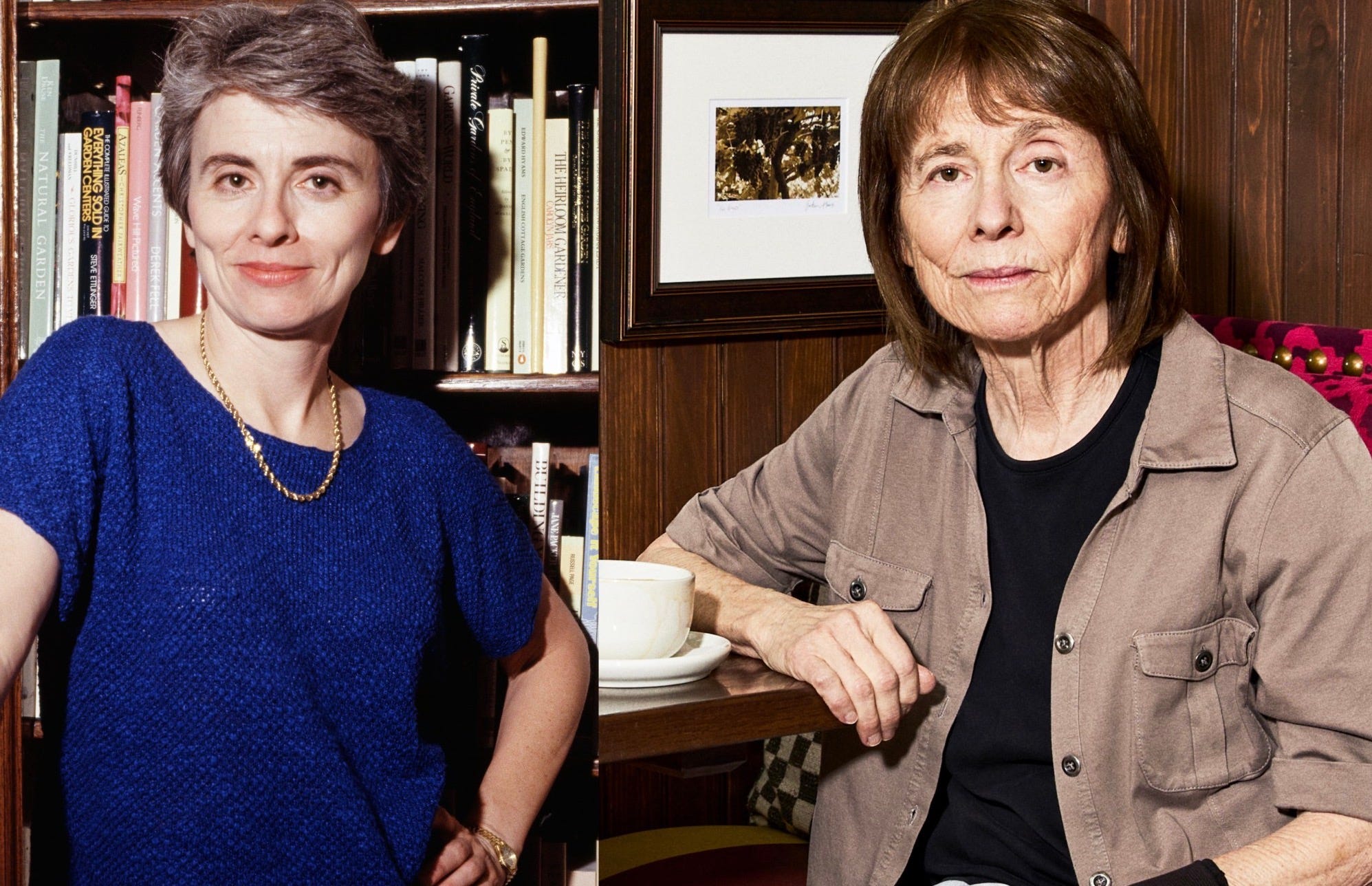
Where is Camille Paglia Today?
Many Paglia-watchers have wondered what Camille has been up to the last year or two.
She has been uncharacteristically quiet, and at her age— she’s 79 at this writing— I’ve wondered if ill health was getting the upper hand.
From knowing Camille back in the day, I’m sure mere physical disability or vanity would never stop her from speaking out and writing. She didn’t have those qualms.
But if she ever encountered cognitive problems, it would be unbearable to her. I mean, it’s awful for anyone. For a quick mind, devastating. She is compelled to dominate, verbally. I knew that age, parenthood, divorce, all humbled her — as such things will. But if she could be part of a conversation, she would.
