Undressing Camille
The Rise and Fall of the Paglia Personae
I first met Camille Paglia, the most famous anti-lesbian-feminist in America (who herself is a lesbian and feminist), during my 1990 book tour for Susie Sexpert’s Lesbian Sex World. I was 32, and she was 43.
I was speaking to a small audience at Giovanni’s Room bookstore in Philadelphia, when a disheveled bag lady jumped out of her seat, and waved her arms as if she were hailing the last cab at Grand Central, yelling, “I am your only friend in academia.”
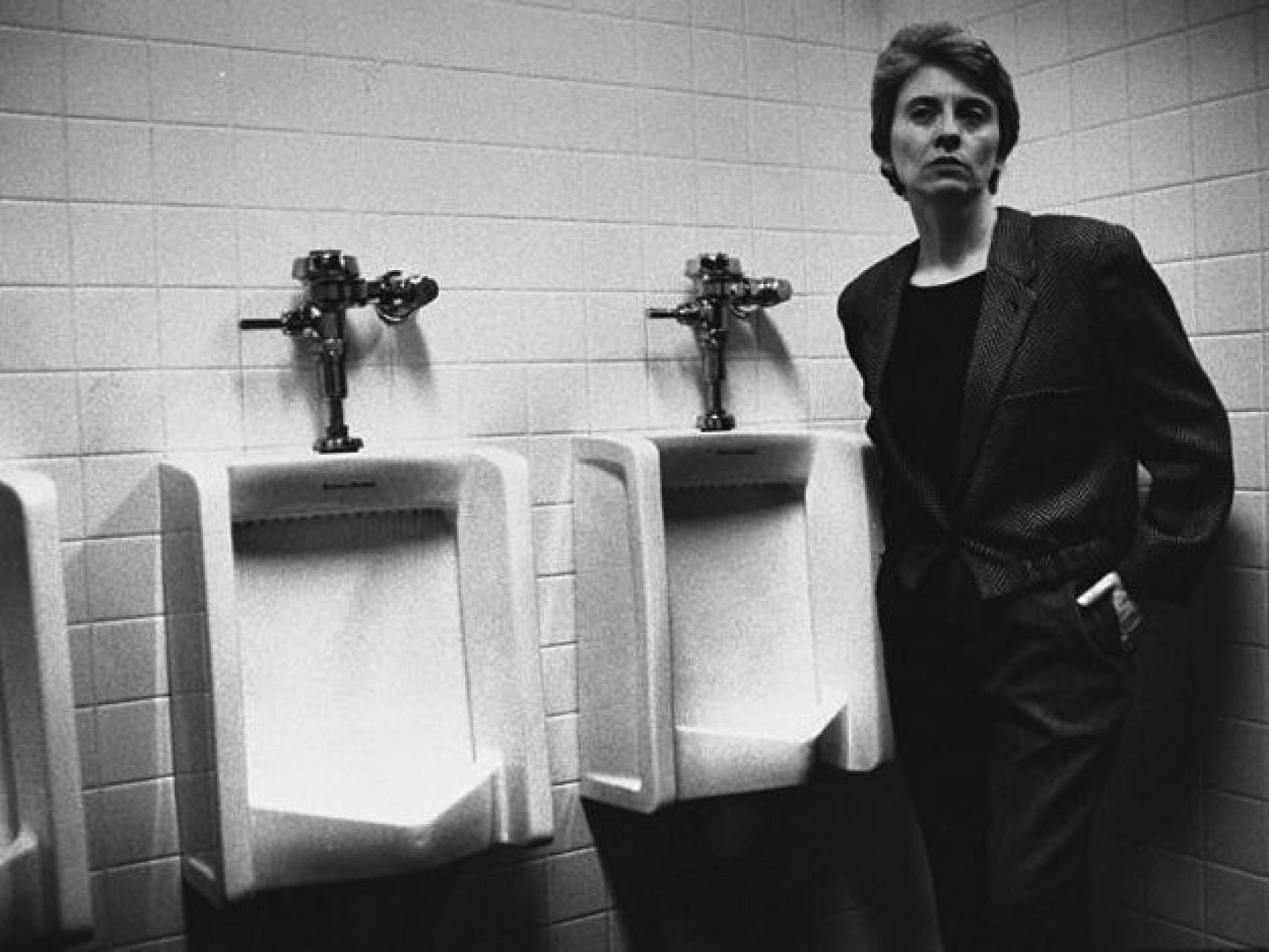
I glanced meaningfully over at the bookstore employees. Security, please! But this woman was unstoppable. She rushed the podium and thrust a handful of papers in my direction: reviews of her newly released book.
Later that night I unfolded the crumpled mess, expecting to read a conspiracy theory of the sort passed out every day at the airport. Instead I found critical praise from highbrow quarters around the world, commenting with great applause and occasional alarm, over Camille Paglia’s grand debut, Sexual Personae.
Soon, Paglia was being quoted throughtout the American press on every sex-related subject from amateur porn videos to sexual harassment. I gleefully read her sarcastic diatribes against the square feminist establishment, all the while thinking, Nobody in the straight world realizes she’s exaggerating for effect.
In Spin, she called the battered women’s movement a “motif.” I recoiled, and at the same time, laughed with black humor, recalling the way so many movements whose beginnings I’d been part of, went on to take cynical turns.
Then, in Esquire, Paglia flatly declared lesbians— as a class!— to be sexually and intellectually “inert.”
Well, you haven’t gotten any in a long time, I thought.
Camille, as it turned out, was the first to agree.
I talked to Paglia on the phone in 1991 from a medieval village in France where I was holed up, writing the sequel to Susie Sexpert.
Later, Ruby Rich quoted Camille in the Village Voice saying, “Susie Bright and I are on the same track.” It was true, we did have a few cars going in the same direction. But as much as she railed against academia, I thought Paglia had been locked in a tower of her own making for too long. How could she truly think that lesbians were the most “conformist” people on the face of the earth? Her claims of men’s brilliance in civilization building and sexual vitality, were ridiculed as demeaning to women, but they were just as simplistic and maddening for many of her male readers.
Men, in Paglia’s book, were incapable of intimacy or a genuine emotional life. She cut a broad swath, and I couldn’t believe she meant it all literally.
Perhaps the difference in our attitudes was one of sexual personae. After all, Camille Paglia is a butch bottom, and Susie Bright is. . . not.
The 1991 Interview
Susie Bright: Lesbians who read what you’ve written and your interviews are secretly laughing because they enjoy many of your criticisms. But when you call lesbians sexually inert, dykes say, “I’d like to throw Camille Paglia down on the floor and fuck her brains out.”
Camille Paglia: Oh, I love it! Who are these women?
SB:You love it? (Laughter.) I could give you a list. Do you remember the night that I met you in Philadelphia?
CP: Of course, it’s burned in my memory.
SB: You popped up like a jack-in-the-box, and you said that you were my only friend in academia. Why did you say that?
CP: You know, I’d heard about you, and then I decided to go see you when you spoke in Philadelphia. You started talking and I absolutely adored you. The way you were talking about sex was humorous, spontaneous, improvisational. I am much more Amazon-like. I could see that since you are not in the academic world, you didn’t understand the degree to which this absolutely sex-phobic, crazed, Moonie feminism has taken over Women’s Studies programs. I’m so happy I do not have any of these amateurish, incompetent, resentful, angry women trifling with my brain.
SB: But about that night we met. . .
CP: The sexual revolution is not just about what you do with your body— it’s about what you do with your mind and that is what I thought was so great about your delivery. You picked up a coffee cup and outlined it to show where the G-spot was and you said to the girls in the room, “Now, this is a penis.” The whole thing was so fabulous.
Because you see, comedy is the secret. Humorlessness is a sign that someone is sick, and what we have got now in American feminism is humorlessness combined with sexual sanctimony and preaching. So, I saw your humor and I said: “This is it. Susie has art and is an artist. That is it. Exactly what is needed.” That’s why I popped up, and you had, of course, never heard of me because I was barely on the scene— my book had just come out.
SB: No, I had heard of you, but I disagreed with you about women studies. I knew what you were talking about when you spoke about the feminist party line, but it’s not unanimous. Not by a long shot.
When I was in Women’s Studies programs in California, I’d have one class that would be prudish, and then I’d walk into another class where the professor would be a sex radical. My first exposure to S/M, butch/femme, etc., was on campus. And so when you said, “I’m your only friend in academia,” I thought, Well, actually, you’re not, Camille; there are lots of people who are openminded.
CP: But they’re not making any impact! They’re not the ones on TV talking about sex. There’s not one voice defending the right to make sexual banter. Instead, the mention of “pornography” in a conversation is denounced as psychotic by people on that Senate committee, and no one refutes them.
The media discourse in America is ruled by sex-phobic feminists. I am now making headway because I am liberating people to say things that they have only been saying privately. Women must blame themselves for their their paralysis, their failure to engage in their own culture. It’s no good being hip in a gay ghetto. Feminism is damaging itself by its own prudery.
“My remarks about lesbians are my form of guerrilla warfare.
It is a criticism that comes from within.”
SB: What did you think when you saw your first issue of [my magazine] On Our Backs? It’s the opposite of everything you describe.
How did you reconcile the women you saw in our pages with your view of lesbians as inert and infantile?
CP: First of all, you have to realize that I am playing a game. My remarks about lesbians are my form of guerrilla warfare. It is a criticism that comes from within, because for most of my life I have identified myself as a lesbian, so there is a lot of parody in what I’m saying. I was excited when I first saw On Our Backs, but I also felt like it reflected a minority culture from San Francisco, a culture that wasn’t easily exported. All the S/M stuff for instance . . . A friend one of my ex’s went to San Francisco, and I said to her, “Listen, there is this S/M scene there and it sounds exciting. What’s going on?”
And she said to me with great disgust, “I could be more S/M in a dress. (Laughter.) That’s what she said.
I would be into S/M if were very young. But as someone who grew up in the fifties, I have S/M in my mind. I think that the intensity of my S/M fantasies is such that seeing people really do it is sort of depressing to me. It’s less in reality than what I had created in my mind all these years ago when I was frustrated for lack of meeting anyone with similar fantasies or attractions.
SB: Tell me one of your erotic fantasies: something that would be physically impossible or that you would never do, but that as a fantasy works beautifully.
CP: Well, this thing now with people strapping on dildos. Who said it? I think it was Madonna— “I’m attracted to women, but basically I like to be fucked.” And then she said, “Well, what about women strapping on a dildo?” And the interviewer said that there would be no point to it, it was a joke.
SB: Oh, that was Carrie Fisher.
CP: And she started laughing. That is my problem with dildos. There is something slightly sordid about them, even though they are very attractive to me. If it came to it, I would try it, but the technology hadn’t advanced yet when I was young, and now I think I’m beyond that. I think I’d feel . . . absurd.
You know, if I was young, I could get into a whole line of scenarios. But now it’s too late for me! I wrote this book that contains my fantasy life, and now I sort of look with bemusement at the rest of the world and I feel almost posthumous in certain ways.
SB: Really, you act like it’s all over for you. These statements from you are a little bit hard to take. You are not that old.
CP: But it’s true, Susie, it’s true!
I had trouble finding women who wanted just sex.
SB: But at this point in your celebrity there’s got to be more than “lack of opportunity” to explain why you’re not having an improved sex life. You’re not going to be able to use that as an excuse.
CP: Well, at this point no, because of the starfuckers and groupies. But when I think about the past, I have to conclude that my level of intensity is really male. What lesbians did not like about me was my intensity. They couldn’t deal with it, whereas straight women, because they are used to dealing with men, never had a problem with me. It took me years and years before I saw this.
All I know is, I never connected with lesbians. I mean, I talk very fast, but even when I wasn’t opening my mouth, something about me was not interesting to lesbians.
Men, on the other hand, have always been interested in me, but my problem with men is that I refuse to play any games of nursing and caretaking or do all the stroking you have to do to keep men going from day to day. What I want from men is good sex— virility.
I had the opposite problem in that I was trying to be dirty with women and I wasn’t finding it. I had trouble finding women who wanted just sex. My entire inability to relate to lesbians is due to the fact I was looking for sex and they weren’t. In the lesbian world you can’t just walk into a bar. Oh no! You have to get into a “musical chairs” group where you have to either play volleyball or do things with them or hang out with them.
SB: Isn’t it like that any place else, though?
CP: Oh, no. That’s not the case with gay men’s bars at all. The people arrive there as strangers looking for sex and it is absolutely admitted that the men are looking for sex. That has always been the case, and I find that so wonderful about men, that they don’t pretend that they are looking for friendship. It is a bold admission of desire.
I think that is my destiny, like the Ancient Mariner,
to go through this wasteland and to suffer and then to write this book.
I accept what’s happened to me.
SB: Have you ever had what you would consider anonymous sex?
CP: Yes, but mostly with men. I was looking for it with women but I wasn’t finding it. That is the story of my life— it’s hilarious. I think that is my destiny, like the Ancient Mariner, to go through this wasteland and to suffer and then to write this book, so I accept what’s happened to me.
I’m sure love will flourish, still. . . the love that always comes to people who are stars. That is not quite the same thing. One should not have to become an international star in order to get good sex, for heaven’s sake!
SB: Was your first sexual experience with a man or with a woman?
CP: Let me think. Are you talking about really early? I think it was with boys. But then girls were later. I’ve been moving towards this idea of bisexuality because I have concluded that straight women are stronger than most lesbians.
Last month, I was in Bloomingdale’s and saw this incredibly butch woman, and I thought, Look at that woman, she is so fabulous! Wow! It turned out that she was a Jewish mother, and I realized the power emanating from her was coming from her control of men, and that was attracting me enormously: her power. I love it! That’s what attracts me. But I rarely find that in lesbians.
But listen, these women who want to throw me down on the floor, what coast are they on?
SB: Name your city!
You said that you’ve called yourself a lesbian most of your life, and yet you save your heaviest criticisms for lesbians. In some ways it makes sense because whatever group one identifies with, one also tends to be hardest on.
But why were you attracted to women in the first place? Why did you call yourself a lesbian at all if you’re so sickened by them that you never connected, nobody would talk to you, you weren’t on the softball team, yadda yadda yadda ....
Something had to make you feel passionate about women. I think we all want to know what it is.
CP: When I began to be attracted to women, they weren’t lesbians. I was attracted to the straight women of the world. That’s who I’m attracted to. The point is, I identified myself as a lesbian before practically anyone.
SB: (Laughter.) Before Christ!
CP: What I mean is, I knew there were other lesbians, older ones, who were in the bars, and working class lesbians in downtown Binghamton, New York. When I was in college, I was dressing in gender-bending ways with ties, and I had my hair short, even though I also had white and blue iridescent sixties eye make up, you know?
I took a lot of shit from straight guys at the college. I wanted to find a woman I could get along with, but the thing was, as lesbian culture suddenly developed, it turned into this feminist thing, and right from the start the feminist thing was anti-art, anti-Freud, anti-this and anti-that, and suddenly I was not attracted to these women who were calling themselves “lesbians.”
In the beginning I liked the old-style diesel dykes. I thought they were great. They were women, older than me, the ones in town, who were like men, and I got along with them. They were funny, they were competitive, they would break beer bottles on the edge of a table . . . I thought they were great! Those are the ones I got along with.
The new group of lesbian feminists alienated me, and so the only affairs I had were with women who didn’t call themselves lesbians. There were a lot of straight women who were “borderline,” and they connected with me and got crushes on me, some developed into major relationships.
For me, some of the greatest moments in lesbian eroticism have been in a heterosexual context. You know that scene in The Conformist when Dominique Sanda is caressing Stephanie Sandrelli’s legs? It’s absolutely blazing with eroticism. I think lesbian sex lost big when it started to think of itself as totally apart from the world of heterosexual sex. It lost a lot of the zap, the sizzle, and it degenerated into what it is now, which is a huge, locked, insular cage.
SB: How come when gay men are together in milieus without women, it doesn’t turn into the same cage?
CP: Well, sex is often a longing for intimacy. Women have an ability to be intimate without getting into bed with each other, this intuitive understanding of each other and people in general, which leads to a fusion phenomenon in lesbian relationships.
Men aren’t capable of being intimate. Ultimately they are blocked from their own emotions. There are some exceptions— artists, some gay men— but most heterosexual men don’t have a clue about what is going on in their emotional lives. When men have sex with men, that desire is a desire for intimacy which has no other way to express itself.
I’m not for intimacy, particularly. I think we have too much intimacy right now.
SB: (Laughter.) Camille, do you really have too much intimacy in your own life?
CP: No, but I think there is too much intimacy in the world. Sex is hottest for me, usually, in the beginning, when people don’t really know each other. And then the minute you start knowing someone, it just gets into this immediate banal thing—“Okay, who’s going to take the shower first? —Your mother’s on the phone.”
I grew up in the fifties. I spent my whole life rebelling against banality!
SB: Camille, who do you tell your secrets to?
CP: Who do I tell my secrets to?
SB: A woman or a man.
CP: Well, I’m particularly close to women. I mean, secrets? What kind of secrets? Either gay men or women. Why?
SB: Well, we are talking about intimacy. I don’t buy it when you say that there is too much intimacy. I know what you’re saying about the thrill of the chase ending, the ennui of domesticity, but that is not intimacy, either. Intimacy and sexual excitement together is intoxicating, don’t you think?
CP: Well, one of my ex lovers went back to being straight, and of course all the lesbians turned on her and said: “How can you betray us? You were the greatest lesbian in the world . . . ”
After a while in lesbian relationships, she got tired of the need to know every thought, to share everything. It was just too much.
The thing about men that is so refreshing is that you sort of pat them on the head and they go off and conquer the North Pole.
SB: Really.
CP: Basically, they are slightly absurd and you get great sex from them, but that intricate fusion of the mental lives is possible only between women and it eventually suffocates the sex— it certainly does for me. Men and women have hot sex because they will never know each other. Men can never truly bond in the way that women can.
I am sick and tired of women retreating to their own world. They’ve got to change the culture without whining about it, about Big, Bad Daddy Patriarchy. And that is why I am going on the attack. American sexuality is puritanical, but in the lesbian world everyone is so damned smug and self-satisfied, always patting each other on the back, all so complacent: “Oh, we’re so fabulous.”
No, they aren’t! Maybe there are pockets that are “fabulous,” but I haven’t been able to find them, and I’ve been looking for twenty damn years. Look at Jodie Foster, always preaching and sermonizing on her pulpit, but does she have the slightest guts to say anything about her bisexuality or lesbianism or whatever it is? No guts! [Foster was not out until 2013]
How about Lily Tomlin? [Not out until 2001]. Constant feminist preaching! No guts whatsoever!
SB: I have a different take on you, Camille, a different card.
I think that you are a butch bottom.
SB: There’s a difference between criticizing actors’ lack of courage and damning all lesbians as regressive. When you do that, Camille, there is nobody left to define as lesbian . . . There’s not you, there’s not me; there’s no one left!
CP: They don’t exist anymore because they’ve become pathetic victims. Sleeping with women is fabulous, and I am only trying to move it outward. I want women to be with women who are straight, who do not close themselves down against male lust.Women, I think, are naturally bisexual. I’m not telling lesbians to stop sleeping only with women, but to leave open a part of the brain toward men and accept male lust and find what is attractive in men and ogle their bodies and do something with that. Then sex with women will be hotter.
SB: I have a different take on you, Camille, a different card: I think that you are a butch bottom. I think you are attracted to femme women who might flip you.
Virile men, you admire them, but you can’t be in love with them. You are also competitive with other lesbians whom you sense are butch but not as butch as you or as good as you, which is typical: The competition for the same girls. Many of them are “butch bottoms,” and they would agree with some of what you say.
When you talk about the banal and stifling aspects of bourgeois life, I understand, we all feel that way sometimes . . . . But when you say you see On Our Backs as a minority experience, it isn’t! Our contributors and readers are from all over the country.
The very fact that you are discussed and controversial in the lesbian world right now, is because you have forerunners. Radclyffe Hall would have a lot of your same gripes. You can’t say, “Oh, Susie Bright is on the same track as I am but she is in a different world than I am,” because you’re not the only one. You really aren’t. There are a lot of dykes sympathetic to some things you say but they can’t go up and shake your hand when you are damning every one of them.
You call it a guerrilla tactic, but there is guerrilla with a “u” and gorilla with an “o.”
CP: (Laughter.) I’m trying to break into these bunkers, and they’re absolutely locked tight. What I am doing is blowing them all open. I just am. People who were invisible are finally talking to each other, or yelling at me for the first time. There is also an element of my revenge in it— no doubt because I am pissed that I spent the best years of my sex life in misery.
SR: What was the last straw?
CP: All those decades of frustration . . . there were a few periods when I was with someone, but mostly I was not getting anywhere at all. Nowhere! I decided I would destroy the present structure by ridiculing it and using the spotlight of my attention to what people don’t dare to say publicly.
And by the way, this is the same technique I use in terms of academia— the same thing. The point is, if my younger life has been miserable, there are a lot of other women whose lives have been miserable, too.
SB: What do you think of my take on your sexuality? Butch bottom or not?
CP: I think that was fabulous! I love that.
SB: Oh, really?
CP; Yes, I don’t know if it’s true, but it gives me a nice little “free feel.”
SB: If you had a cock for a week, what would you do with it?
SB: How do you feel when people call you a fag hag?1 Does that upset you, or do you laugh and think, “that’s true.“
CP: Well, I certainly love that phrase. Some of my most intimate relationships have been with gay men. I have been influenced by gay men. The way they value their beauty and art and their interest in pornography, the level of their sexual desire, their elitism . . . . I believe in the elitism of talent. I can’t bear the egalitarianism in feminism: Heaven forbid we should make any qualitative judgments about anything.
SB: If you had a cock for a week, what would you do with it?
CP: Well, I would have liked one twenty or even thirty years ago. There was a period when I felt it would have solved all my problems because the women I was interested in, were straight. Now, thought, it would be a pain in the ass having that thing in there all the time. That’s my attitude.
SB: You talk about the idea of victimization in feminism, and yet in this conversation you’ve referred to yourself as being, sexually and socially, a loser.
CP: No, maladjusted. A loser is someone who is depressive and passive. I was always an activist. I was a rebel and I was burning with anger from the start. I’m saying that conflict and combat and angst and anguish all lead, eventually, to great achievement. And they have certainly done so in the figures that I admire— someone like Michelangelo, the turbulence in his character. What I don’t like in the lesbian world is that it’s so damn cozy.
SB: Are your parents alive?
CP: Well, my father just died earlier this year after two years of being ill. My mother is alive, yes. [Lydia Paglia would die in 2015].
SB: So, what did they think of your book?
CP: Well, I wouldn’t say either of them has read it, but my father read some of it. He was a professor. [Romance languages at Le Moyne College].
SB: Was he surprised how famous you are?
CP: Famous? I’m famous, but I’m not that famous. I’m not a household word yet.
SB: You are in my household.
CP: Yes, I’m a Cosmo girl now. Listen, I was in Boston two nights ago, and a woman from Russia plopped down this magazine for me to autograph. I’m on the cover of a magazine in Russia! I said, “What the hell is this?” It was a reprint of my Playboy interview, and they illustrated it with pictures of a streetwalker from Kiev, which I loved, and I thought, My god, there are streetwalkers in Kiev that now know that I, Camille Paglia, support them in sex work!
They had reprints of other articles about me from Japan, Taiwan, Holland, Brazil, Portugal, Australia, you name it! What’s happening is like a world phenomenon! What I’m doing is putting the idea of women as intellectuals back on the map. I am a real feminist.
SB: Some read your arguments about masculinity signifying sexual freedom and that women will have to be willing to accept certain risks, like date rape, if they want this freedom. Really? Your conservative fans say, “That’s right. Women should wear veils. Women should not go out at night because they are not prepared to handle sexual freedom.”
CP: You can’t believe that I have to be responsible for people misreading what I am saying and having half-baked ideas about me! I am a new thinker; I have just come on the scene, and I have the most comprehensive vision of sexuality in the world right now.
As for myself, I feel I’m a sexual freak. My life in that area has been kind of miserable. Yet I have the compensation of writing this pornographic, massive book which eroticizes everything in history, and now the book is seducing other people, too! The book seduces people for me.
Part 2 - Tomorrow!
Camille’s Fury Turns Upon Me
Our tentative mutual respect from the 1991 interview was not to last . . . a year later, the dime dropped.
Read it all in Part 2: “Camille Anonymous.” I have also narrated it in audio.
In Case You Missed It
See Camilla DeCarnin’s story, Interview with Five Fag-Hagging Women. Another “Camille” worth knowing!


The reason this interview happened was because a “young genius” editor named Maer Roshan, started a short lived but influential gay NY zine in 1992 called “NYQ”, and he contacted me out of the blue, and said, “You’re the only one who can do this.”
Those of you in journalism know Roshan has had a meteoric career and is now EOC of the Hollywood Reporter. He got out of NYC! LOL>
I think even he was surprised at CP’s candor with me. It was just one of those moments. She wasn’t yet famous, but the story and her book exploded (a favorite word of CP’s) almost the next day.
She would never speak like this again, in public. But in person, as you can see, she is very funny and her hyperbole is unrestrained. Oscar WIlde indeed.
This is so good, Susie. I'm glad you shared it and can't wait for the next installment.