
The Irish Side
The despised and the beautiful

Irish are Spaniards who got lost in the mist. . .
—Spain Rodriguez
The first person in my mother's family who came to California was my great-aunt Tessie Halloran, who went to make her living as a governess in a Hollywood home.
She came home to Minnesota one Christmas, a success, loaded down with navel oranges and wearing a two piece suit the color of a peach. No one in my family had ever worn any other color than blue or black or brown. The children didn't know that a peach-colored fabric existed, and when they touched Tessie’s outfit, they worried that it would melt away like ice cream.
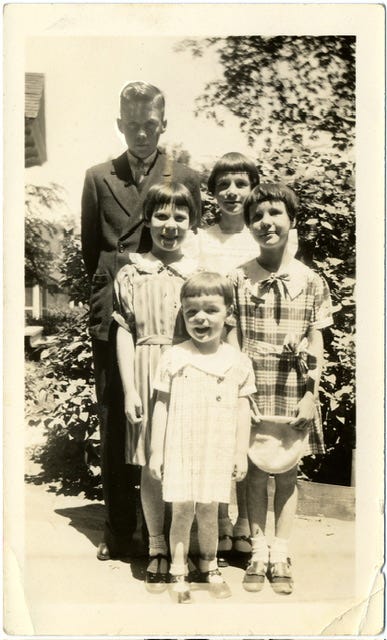
In St. Paul at the time, there were signs on respectable establishments that said, “No Dogs, No Indians, No Irish.” There was no work in the ghetto, and Tessie’s good fortune out West was intoxicating. Soon one Halloran after another was either joining the service or moving out to San Francisco to work in the Hunter’s Point shipyards.
My mom stopped speaking and corresponding to her blood relatives when I was seven, after several years of brinkmanship. It started out, from what I could see, as a solitary silent treatment against her father, who she never introduced me to. Nor did I ever see her turn to him for a look or a word. Not once; his eldest daughter. That was Jack Halloran.
Then there was her brother, Patrick James, “Bud.” I never met him, the oldest of the five, and my mom would only reluctantly offer his name, spilling out a few tearful words: “I worshiped Bud, when we were kids.”
My father Bill, the “leak” for every fact of my maternal history, told me that Uncle Bud had joined the Army, was a sergeant of a division in the CCC, and was a regular war hero— but that he came back a regular drunk. He abandoned his wife and eight children just like his father had done to him.
My mom would sob, as if marked for damnation, “And I introduced him to Georgia—” Bud’s wife. I never met Aunt Georgia, either. She looks so pretty in her Red Cross outfit in a portrait I discovered in my mother’s hat boxes, nineteen years old. My family threw themselves into the war effort. But my mother could not face Georgia again either, for the sin of her matchmaking.
The shame of all the history, the errors, the regrets. A river you could drown a city in. “No Dogs, No Indians, No Irish.” There was something about being the last group on that sign, that signalled the last nail in the coffin.
Why were the Irish so despised?
They were dirty, they were drunk, they were hungry, and they were liars— the final two being somewhat related. And their religion was full of smoke and powders and infinite chambers of ghosts— mysteries for the sake of mysteries.
My mom didn’t drink. I rarely saw her with a beer. She was obsessive about cleaning up one side and down another. If I never scrub another floor again it will be one too many.
One time when I was just little, she put two yardsticks like a giant “X” on the bare floor, and taught me an Irish jig. She laughed and threw her head back, the sweat making her flat hair curly. Her feet never tripped or hesitated. She could sing or recite epics that went on verse after verse, as if she was inventing them on the spot. Maybe she was.
But if we were around other Irish Catholics who did the same things, the corners of her mouth drew tight. She was thinking something vicious, and her parting words would pinch as hard as her hand on my shoulder, to steer me away from “that awful clan.”
She’d take me to church, refuse Communion for herself, and after all that trouble to get dressed up in our patent leather shoes, she’d leave at the end of the service, furious that they’d given up the Latin, and provoked at the priest’s banality. “Those Bastards!” she’d say.
When I was in my thirties, I got an invitation from a gay group in Belfast who invited me to speak at an exhibition. I was flattered and thought, “Here’s something I can tell Mama and she’ll be proud.
She was ticked off. “Who’s paying for it, Susie?” she asked, as if she’d just caught their hand in her pocket.
“Don’t trust a word they say,” she said, when I told her the hosts were still fundraising. “Don’t you forward them one penny, because you’ll never see it again.”
My mouth dropped. My mother, who wouldn’t tolerate a single ethnic stereotype— was a bigot when it came to our cousins across the way.
My mother was born in Fargo, ND, christened Elizabeth JoAnn and nicknamed Betty Jo. Then just Jo. She was the first of the first generation to break away. Patrick James, Betty Jo, Molly, Fannie, and Pid— but she was the “smart” one. People who’ve wondered what my parents had to say about my path have no idea that my parents were the ones who broke the cardinal rules, not me. My mom was the first in her family to go to college. The nuns told her she would burn in hell if she attended the public University of Minnesota in Dinkytown. She cackled, reliving the story every time, proclaiming, “I couldn’t wait.”
She was the first in the family to marry outside of the faith, to divorce, to bear only one child. More importantly, she didn’t die bearing children— the number one cause of death among Halloran women.
She played footsie with my father in Greek class. She was the first girl he ever kissed. She and he agreed, in separate conversations with me, that he was the only straight man studying classical languages and anthropology at the University of California. When I “came out” to my parents, it was anti-climatic— together, they’d had far more of a gay social life and witnessed more emerging queer history after WWII than I’d seen in my lifetime. They preferred gay life, intellectually, socially. Yet they were relieved to find each other, an erotic and intimate connection in an otherwise lavender universe. My dad would say, “I wondered if I was gay. But I dreamed about Rita Hayworth, Esther Williams, and your mom.”
My mom would never have described herself as a fag-hag, first of all because she would never, ever use an epithet, no matter how good-natured— and secondly, because she really thought of herself as Lucy Van Pelt, completely fed up with virtually everyone.
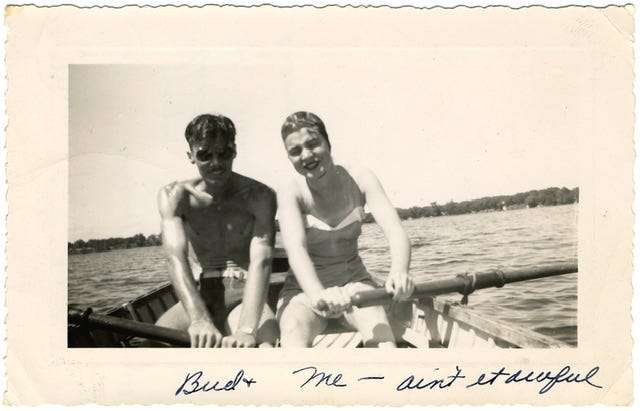
When my Aunt Molly died, (the one sister who didn’t let my mother disappear altogether), I found out that Molly had collected what was left of the Halloran family scrapbooks. I was amazed to find a “baby book” for my mom and her brother, that their mother Agnes had kept until the first two kids were toddlers. I was shocked at the prosperity the little book implied. How could they have kept a lovely illustrated diary like this when a few years later my mom was on the street collecting rice in her apron from Relief Wagons?
My grandmother Agnes died in my twelve-year-old mother’s arms while the little ones screamed in same one-room apartment, in hunger and filth. Her family’s farm had been foreclosed, her husband had abandoned her.
But in her teens, my grandmother had another life. She was the glamourous Nickelodeon piano player. When Agnes was first married, things were. . . okay. She had the time and good health to make a baby book. Her husband Jack’s writing was beautiful and filled some of the pages with their first two children’s accomplishments. Jack was selling tractors for John Deere, and he would send perfectly fountain-penned postcards from the road: “Wish you were here; kiss the babies.”
“Yes, he was famous for his hand,” my mom admitted when I showed her the evidence that her father was once something more than a basket case.
She looked at the postcard I showed her as if it was a museum piece, not connected to her. How could this be the same guy who hid out and let the orphanage come pick up the children when his wife died, the man whose hands shook in photographs, and looked like Ichabod Crane in his black duster?
The baby book was composed before the crash, in the mid-20s, before the banks took Grandmother Halloran’s farm, before skid row claimed my grandfather’s allegiance. The baby books were full of promise. On the page where the doting parents record “Baby’s First Word,” instead of “Da” or Mama”, Elizabeth first word was: “Bud.” Written in that beautiful cursive pen.
When my mom was dying a few years ago, she was on a lot of morphine, and she gaily told stories I’d been waiting to hear all my life. I wasn’t ready for it; I’d given up so long ago to ever hear anything from her lips.
When I was little in Berkeley, I would make the mistake of asking, “What was it like when you were my age?”
She’d cry as if I’d stuck her with a pin, her face accusing me as if she was the little one and I was too cruel. I didn’t ask her again after I started to read.
When my mother died, cancer protruding over her body in fist-sized lumps and bumps, she wasn’t grieving. She could recite a chapter of her life without blinking, even laughing at it. She didn’t cry at all, except when she was looking for her grandmother, in bouts of sleepwalking.
I realized after one of her nocturnal walks that my mom could barely remember her birth mother, because her only childhood memories were of a sick and dying woman, usually pregnant. “Mama” was a saint, not a person.
Instead, my mom looked to her real mother figure, her grandmother. “My grandma,” she told me, during one of her loquacious Fentanyl patch moments, “was the only person in my family who ever praised me or told me I was good. She told me I was smart and I could do anything.”
Forty-plus years it took to hear that.
My mother was a star; when I meet people who still remember her, they shake their heads and remember an incandescent anecdote, where she burned hot, either in temper or passion or blistering empathy. She felt things so deeply, and she could bury them just as long.
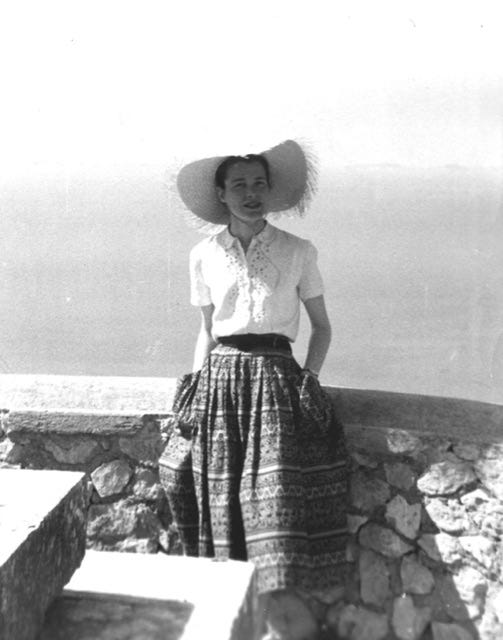
Elizabeth told me a story one morning, when we were meditating on the plum blossom outside her window. “When Grandma still had the farm,” she said, “there was a fence at the edge of the property right on the highway, where the Greyhound bus passed every day on its way west.
“There was a song on the radio I liked then, it was Rudy Vallee, he was all the rage— “The Red River Valley.”
I've been thinking a long time, my darling
Of the sweet words you never would say
Now, alas, must my fond hopes all vanish
For they say you are going away
“I would sit on that fence post every afternoon!” She laughed as if the memory of her legs swinging on the fence was a comic newsreel. “I was waiting for the bus to come by, bawling “The Red River Valley” at the top of my lungs. I knew that one day the bus driver would hear me and everyone on the bus would clap their hands and they’d stop the bus and pick me up and take me out to Hollywood, where I would be a big big star!”
I could see the plough behind her, and our California destiny— way, way out, in front of those steaming wheels.
superb; i love your mother's outfit
I enjoyed this. A excellent quote by Spain Rodriguez..